

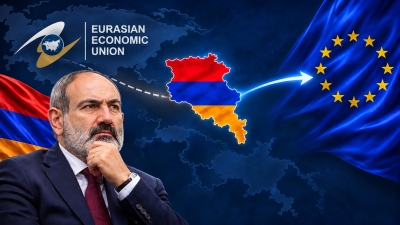
Armenian Prime Minister Nikol Pashinyan stated that Yerevan has no choice but to withdraw from the Eurasian Economic Union if it wishes to move toward the European Union, opening a new chapter in the country's relations with Russia and challenging one of the most important Russian geopolitical projects of the post-Soviet era
There are statements that cause noise for a few hours. And there are statements revealing that an entire geopolitical era may be coming to an end. Or perhaps not. The stance of Armenia's Prime Minister, Nikol Pashinyan, undoubtedly belongs to the second category. Speaking about his country's European perspective, the Armenian leader stated that the path toward the European Union leads inevitably to withdrawal from the Eurasian Economic Union (EAEU). "We have no choice," he noted characteristically, adding that Yerevan is approaching the moment when it will submit an official application to initiate the EU accession process in the 2027-2028 period. This represents one of the clearest and most direct statements the Armenian leadership has made to date regarding the country's strategic orientation.
 Nikol Pashinyan
The moment balances shift
The statement acquires particular significance because it does not concern only Armenia. It also concerns Russia. For over a decade, the Eurasian Economic Union constituted the central economic vehicle of Russian foreign policy in the post-Soviet space, the so-called "near abroad." For Moscow, the EAEU was not merely a customs or trade agreement. It was the most tangible step toward constructing a Eurasian economic space, a broader geopolitical power pole that could act as a counterweight to the European Union, as well as a mechanism for preserving Russian geopolitical and geostrategic influence over former Soviet republics.
In certain circles of Russian geopolitical thought—the Eurasian school—these societies are considered part of a shared Eurasian cultural space, possessing historical, economic, and cultural ties with Russia. Since its founding, the union included Russia, Belarus, Kazakhstan, and Armenia, while Kyrgyzstan joined later. In Russian geopolitical thinking, the EAEU was presented numerous times as the core of a broader Eurasian economic integration. Not military. Economic. And precisely for this reason, Pashinyan's statements acquire extraordinary weight.
 EAEU
Putin's Eurasian dream
Vladimir Putin has repeatedly presented the Eurasian Economic Union as one of the most important geopolitical achievements of the post-Soviet period. The logic was simple. If the European Union constituted the mechanism for West European economic unification, then the EAEU could constitute the corresponding mechanism of the "Eurasian" geoeconomic zone, in the narrow sense of the term. That is why the withdrawal of a member state always carries exceptional significance. Especially when concerning a country like Armenia, which was considered for many years one of Moscow's traditional South Caucasus allies. It is no coincidence that Putin himself had warned Yerevan in the past—and on more than one occasion—about the potential consequences of such a choice. He had stressed that Armenia would lose its access to free trade regimes and economic agreements provided by participation in the Eurasian Economic Union.
The trauma of Nagorno-Karabakh
Armenia's shift did not occur suddenly. In recent years, bilateral relations between Yerevan and Moscow have endured severe trials. Developments in Nagorno-Karabakh during the armed conflict with Azerbaijan, the criticism leveled against Russia for its posture in the region, and the growing dissatisfaction of a significant segment of Armenian society created an entirely new political environment. The Pashinyan government gradually began seeking alternative geopolitical and economic pillars. Within this framework fits the rapprochement with the European Union. Not as a symbolic gesture, but as a strategic geopolitical shift.
Europe as a guarantee for the future
In Yerevan, the view appears to be gaining ground that the long-term security and development of the country are tied more closely to European integration than to traditional structures dominated by Russia. Whether this strategy will prove successful is an entirely different discussion. EU membership negotiations represent a complex process requiring years of talks, radical reforms, and courageous political decisions—one need only consider the example of the Western Balkans to comprehend the depth of the undertaking's complexity. Yet the message transmitted by Pashinyan did not concern technical details. It concerned geopolitical direction. And the direction he described leads straight toward Brussels.
A statement that will be read carefully in Moscow
In the South Caucasus, words frequently hold greater weight than official decisions themselves. A prime minister may not immediately announce a withdrawal. He can, however, announce his intention to change course. And that is precisely what Nikol Pashinyan appears to have done. For Armenia, a landlocked country positioned between the Russian and Iranian spheres of influence and facing historical tensions with Turkey and Azerbaijan, the statement resembles a public pre-announcement of a historic pivot. For Russia, conversely, it functions as a reminder that the Eurasian project designed as an answer to European integration now finds itself facing its own centrifugal forces.
Ukraine appears definitively lost to this logic of integration, at least as long as the current political leadership remains in Kyiv. Now, even Armenia, one of the most loyal members of the Eurasian Economic Union, appears to be seeking a different geopolitical direction. If Yerevan ultimately transitions from statements to formal decisions, the greatest consequence may not concern Armenia itself. It will concern the viability of the most ambitious post-Soviet project constructed under Russian geopolitical leadership. Because then, for the first time since the creation of the EAEU, a political choice by Moscow will not merely be challenged. The very attractiveness of the Eurasian model—which aspired to unite the post-Soviet space, the region that Sir Halford Mackinder, father of Anglo-Saxon geopolitics, described as the famous Heartland geopolitical core of the Eurasian supercontinent around which Great Power competition perpetually revolves—will be thrown into doubt...
www.bankingnews.gr



Σχόλια αναγνωστών